
Short answer: There are several ways to identify sensitive personal data within your systems – either manually or using digital tools. A manual approach can be manageable for smaller datasets but requires time and structure. Digital tools can help automate the process and provide a faster overview, especially when dealing with large volumes of data.
The start of good data management
Identifying and locating sensitive personal data within your company is essential for complying with regulations like GDPR, maintaining customer trust, and improving data management. Without a clear overview of where data is stored, you cannot protect it against breaches or attacks, which can have serious consequences. It’s all about ensuring security and responsible data handling.
This blog will guide you on how to locate sensitive data within your organisation.
Did you know that GDPR violations can result in fines of up to 20 million euros or 4% of the company's global annual turnover, whichever is higher
- European Commision
Why you should locate your sensitive data
It’s essential for businesses to identify and locate files containing sensitive information – and here’s why:
- Compliance: Regulations like GDPR in the EU require businesses to protect personal data. Without a clear overview, you risk breaking the rules, which can lead to fines and legal consequences.
- Customer Trust: Leaks of sensitive information can damage your reputation and erode customer confidence. If you don’t know where your data is, you can’t effectively protect it from breaches or losses.
- Improved Data Management: Identifying and organizing sensitive data helps you keep track of what information you have, where it’s stored, and who has access. It’s also crucial for responding quickly to data breaches or cyberattacks.
Finding and securing sensitive data isn’t just a good practice – it’s a necessity for ensuring responsible and secure data management.
Need help managing personal data?
In our newsletter you get tips and tricks for dealing with privacy management from our founder Sebastian Allerelli.
When you sign up for our newsletter you get a license for one user to ShareSimple, which will give you a secure email in Outlook. This special offer is for new customers only, with a limit of one freebie per company.
Things to consider before you start
Cleaning up sensitive personal data is not just a matter of deleting random files. It starts with understanding where your data is stored – and what you’re actually looking for. In many organisations, data is scattered across local drives, shared folders, email inboxes, cloud storage and online platforms. Employees save and share information differently, making it difficult to get a complete overview.
It’s also essential to define what qualifies as sensitive personal data in your specific context. GDPR’s definitions are broad – health information, trade union membership, political beliefs and ethnic background are just a few of the categories that require special attention. Without a clear understanding of what to look for, you risk wasting time in the wrong places – or missing something critical.
These considerations are key before deciding how to approach your cleanup. The method should match the size of your data, your IT landscape and your available resources. Manual work can make sense for smaller organisations with limited systems. But in larger organisations – or where data is widely dispersed – tools that can automate parts of the process are often essential. Regardless of the method, effective cleanup requires planning, oversight and accountability.
How to find your sensitive personal data manually
When locating your files, emails, and images containing personal information, start by selecting your method for identifying sensitive personal data. It’s crucial to choose the right method to ensure you identify every ID number, credit card number, medical condition, political opinion, etc., that has made its way into your data systems. And the cleanup must still be completed within a realistic timeframe.
There are three main methods for locating your sensitive personal data:
- Do-it-yourself: Assign one or more employees from your company to locate the files. This option can be expensive due to its time-consuming nature and carries a high risk of human error. The process may also expose your data to risks if not performed correctly. There are many challenges when it comes to manual cleanup. But if you still choose to do it yourself, I’ve put together a guide on how to clean up sensitive personal data.
- Hire consultants: Engaging a data-search consultant or agency to locate your sensitive files is an option, but it comes at a high cost.
- Use a smart tool: A smart Data Discovery tool that automatically identifies sensitive personal data within your systems is an easy and cost-effective way to clean up files containing sensitive information.
FAQ about finding sensitive personal data
1. What is sensitive personal data?
Sensitive personal data includes information such as health records, political opinions, religious beliefs, trade union membership, sexual orientation, as well as genetic and biometric data.
2. Can sensitive data be found manually?
Yes, but the process is often time-consuming and imprecise. Automated tools provide faster and more accurate results.
3. Is sensitive data only relevant for large companies?
No, any company that processes personal data about customers, employees or partners may handle sensitive information.
Stop the GDPR monster before it gets its hold of your personal data
A smarter way to find your sensitive data
Instead of spending hours every month manually searching for data that contains personal information, you can use a digital tool to complete the task much faster and far more accurately.
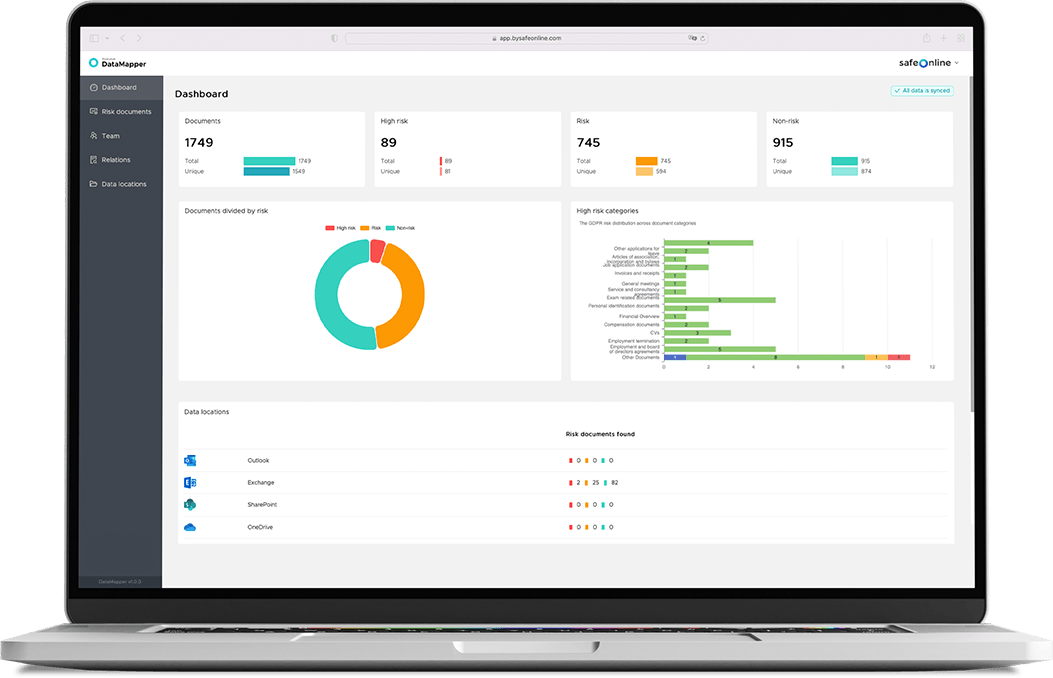
At Safe Online, we offer a GDPR Risk Assessment that analyses your files, emails and documents across the organisation and identifies where sensitive personal data is stored. The assessment gives you a clear overview of your data risks and shows exactly which information requires action. It’s the effective way to locate sensitive personal data — without manual effort.
Learn more

Sebastian Allerelli
Founder & COO at Safe Online
Sebastian is the co-founder and COO of Safe Online, where he focuses on automating processes and developing innovative solutions within data protection and compliance. With a background from Copenhagen Business Academy and experience within identity and access management, he has a keen understanding of GDPR and data security. As a writer on Safe Online's Knowledge Hub, Sebastian shares his expertise through practical advice and in-depth analysis that help companies navigate the complex GDPR landscape. His posts combine technical insight with business understanding and provide concrete solutions for effective compliance.